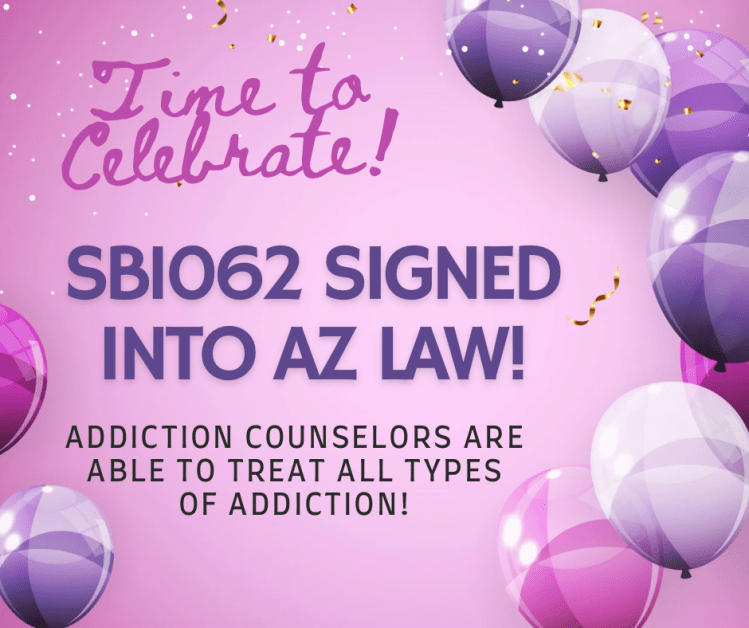
SB1062 was signed into law by Governor Hobbs on 4/23/24! When the law goes into effect on 9/14/24 (the general effective date, 90 days after the 2023-2024 AZ legislative session ended), “Substance abuse” counselors will become “addiction” counselors and able to work with clients with non substance-related addictions! (All ethical standards apply, including the mandate to only work within the professional’s competency – including education, training, and supervision or peer consultation.) AAAP is dedicated to providing more opportunities for training and supervision in behavioral/process addictions and supporting the workforce through this necessary and proper change.
In addition, due to a floor amendment, out-of-state residents will only need 1 year of licensure to be eligible to apply for a license of the same level via AZ Board of Behavioral Health Examiners. (This is reduced from 3 years in current statute.). We know this will help increase our behavioral healthcare workforce and increase access to care for Arizonans!
Thank you to all who worked on this legislation, including Sponsor Senator T. J. Shope and lead Sponsor of companion bill HB2279 Representative Matt Gress (and all co-sponsors).
Want to be a part of legislative advocacy like this? Join the Arizona Association of Addiction Professionals today! All you need to do is join NAADAC, The Association for Addiction Professionals – all members who live/work in AZ are automatically members of AAAP! Our public policy committee is always welcoming new faces and ideas.
Special thanks to all members of the Public Policy Committee who dedicated countless volunteer hours to making this legislation happen, including AAAP President Yvonne Fortier (this was her vision for YEARS), Committee Chair Robert Daughenbaugh, Jr. (who lobbied legislators and testified masterfully), AAAP VP for Central AZ Trish Hernandez (who advocated fiercely and helped analyze research), Secretary Nikki Fordey (who kept us organized and focused on our goals), and all who wrote their legislators and/or submitted testimony in support of SB1062!
FAQs on SB1062
Can I start working with all addictions now that SB1062 has been signed into law?
The law will not become effective until 90 days after the 2023-2024 legislative session ends, 9/14/24. Therefore, clinicians must wait to work under the new definition of addiction counseling until the law goes into effect. In addition, clinicians are reminded that they still need to work within their personal competency, only treating conditions in which they have training, education, supervision, etc. and to refer to AZBBHE rules and laws as well as the NAADAC Code of Ethics for guidance.
Will there be a title change? (In other words, will the name of the addiction counselor licenses change?)
Yes. SB1062 lists the new license titles as Licensed Addiction Technician (LAT), Licensed Associate Addiction Counselor (LAAC), & Licensed Independent Addiction Counselor (LIAC).
What do I need to do if there is a title (license name) change?
No action is needed at this time. Once the law is in effect and Boardal has been updated, licensed addiction counselors will be able to download a new license in the Boardal online system with their new title. Upon their next renewal period, all licensees will have the new titles reflected on their new licenses.
What addictions are included when it says addictions that are persistent, compulsive dependence on a behavior or substance?
There is not an exhaustive list. Rather, it is the responsibility of the clinician to become educated, trained, and receive appropriate supervision and peer collaboration to develop competency in treating the target condition using evidence-based interventions. Some examples of process/behavioral addictions and further information about how a behavior can be addictive can be found at the Mental Health America site.
Do I need to be certified to work with behavior or process addictions?
Specific certification is not required by SB1062, however, certification is one pathway to demonstrate competency in working with process/behavioral addictions. Other pathways include CEUs, observation, practicum, supervision, post-grad classes, etc. What this law does is put addiction counselors at the same level as other professions regulated by AZBBHE that are permitted to work with the populations and utilizing the interventions in which they are competent. Certification is only one manner to demonstrate competency to clients, if asked, or the Board, if for example there has been a complaint.
Are there trainings to further education and knowledge to work with individuals in specific behavior or process addictions?
Absolutely. We would encourage starting with the training offered by NAADAC, however there are many other available trainings in this area. For example, Mental Health Academy offers a micro-credential in working with behavioral addictions. Addiction counselors interested in treating problem gambling may find the available resources with the AZ Department of Gaming helpful.
Are there trainings offered in Arizona?
AAAP is in the process of developing such specific training and collaborating with sister organizations. Are you an addiction professional who could lead a training on behavioral/process addictions? Contact AAAP Secretary Nikki Fordey at nikkif610@gmail.com. A more formal call for presentations is in development.
How do I ensure best practices since SB1062 has been signed into law?
Each individual is responsible for ensuring best practices in their work. SB1062 does not change this by being signed into law. Utilizing best practices for process/behavioral addictions requires the same tools we would use to determine best practices for substance-related interventions.
What impact does SB1062 have on the testing required for licensure?
There is no change to testing required for licensure at this time. It is possible that curriculum related to behavioral/process addictions could be added to testing materials in the future, but there are no plans or changes happening at present.
Has the AZBBHE issued new rules to be consistent with the changes in SB1062?
AZBBHE has issued a notice of docket opening for rulemaking (on page 2238 of this document). Once a notice of proposed rulemaking is available it will be linked on this website. There will be a 30-day public comment period. However, AZBBHE can be contacted via:
| Polly Knape | Deputy Director, AZBBHE | (602) 542-1811 | polly.knape@azbbhe.us |
if you or your organization have suggestions or comments on rule changes that you would like to see in this rulemaking package. More information on the rulemaking process can be found at the AZ Governor’s Regulatory Review Council website.
 Arizona Association of Addiction Professionals